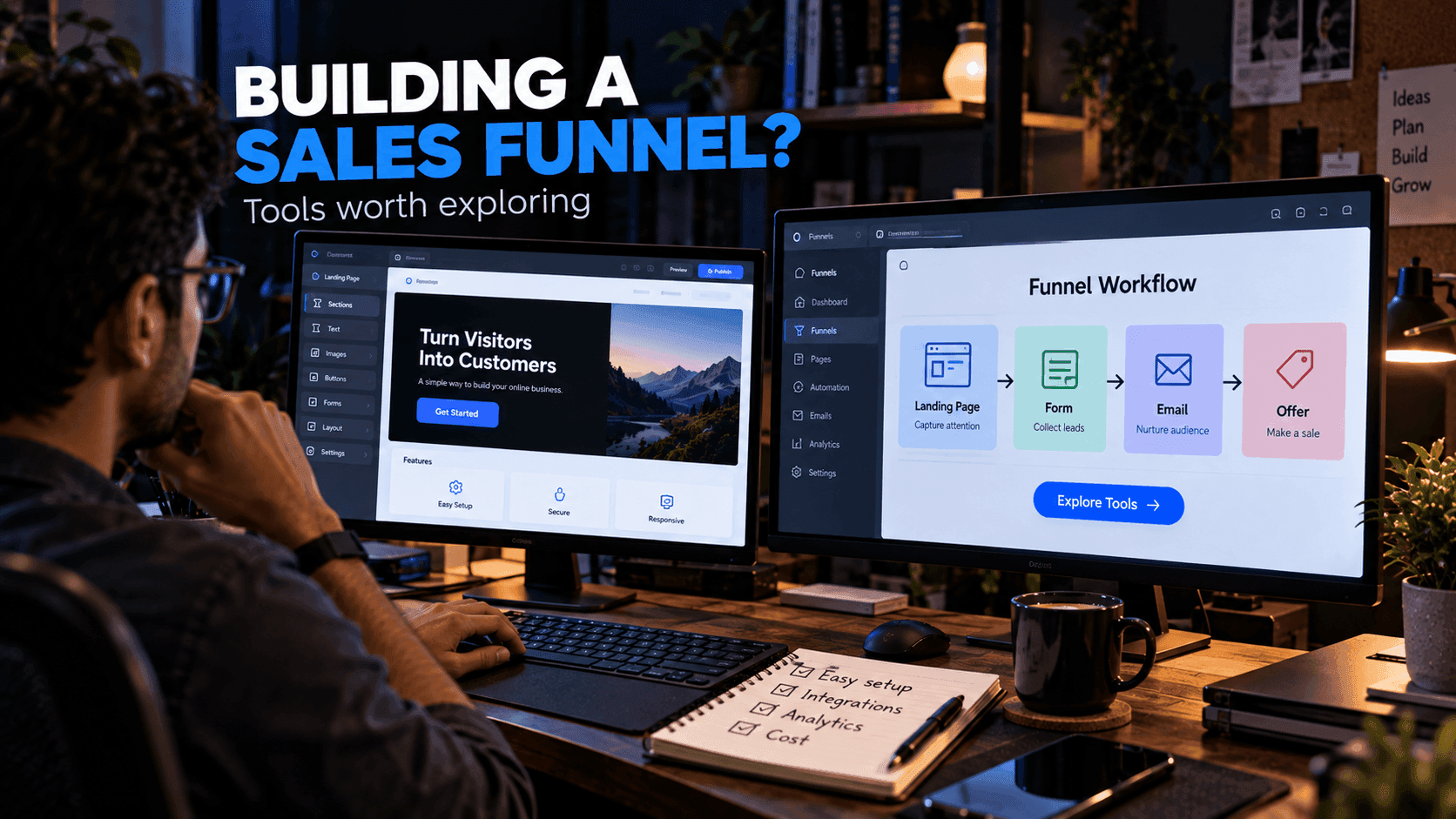
Building a sales funnel can involve several separate systems. You may need a landing page, a form, an email platform, a payment system and analytics, all working together.
The best setup depends on the complexity of your business, your technical skills and how much control you want. This guide explains the three main approaches, how to compare tools fairly and a simple test you can run before committing.
Quick answer: You can build a funnel with custom code, a combination of separate SaaS tools, or an all-in-one platform. Developers who need full control often code it; beginners and small businesses often prefer an all-in-one platform. Test one simple funnel in each option before deciding.
New to funnels? Start with what is a sales funnel for the basics.
What Should a Funnel Tool Provide?
When evaluating a platform, consider:
- Landing pages: building and editing the pages in your funnel
- Funnel management: linking pages into ordered steps
- Forms: collecting signups and contact details
- Email integration: sending follow-up messages automatically
- Automation: triggering actions such as tags or emails based on behavior
- Payments: checkout and order forms for paid offers
- Analytics: seeing where visitors drop off
- Integrations: connecting with tools you already use
- Custom domains: publishing on your own domain
- Ease of use: how quickly you can build and change things
Not every project needs every feature. A free-download funnel may only need pages, a form and one email. A product launch may need all of the above.
Option 1: Build Your Own
Developers can build funnels using a modern web stack.
For example:
- Next.js or React for the pages
- Node.js or serverless functions for form handling
- A database for leads and orders
- An email API for follow-up messages
- A payment provider for checkout
- An analytics tool for measurement
Advantages: Complete control over the user experience, design, performance and architecture. Nothing is limited by a platform's feature set, and you can reuse components from your main site or from our free templates.
Trade-offs: Maintenance. You are responsible for connecting each component, handling errors, managing unsubscribes and privacy requirements, and keeping everything working as services change. Every small marketing change may also require a code change and a deploy.
Best for: Developers and teams with engineering time, highly customized products and funnels that are core to the business.
Option 2: Use Separate SaaS Tools
Another approach is to choose a dedicated tool for each task.
For example:
Landing page tool + email platform + payment system + analytics
Advantages: Each tool can be excellent at its specific job, and you can replace one piece without rebuilding everything.
Trade-offs: More accounts, more integrations and more recurring costs. Data has to move between tools, and when something breaks it can be hard to tell which service caused it.
Best for: Businesses with specific needs in one area, such as advanced email automation, and the time to manage integrations.
Option 3: Use an All-in-One Platform
An all-in-one platform brings several functions together: pages, funnels, email, checkout and often courses or other products.
systeme.io is one platform you can evaluate for this approach. It combines landing pages, funnels, email marketing and tools for selling online products in one account. For a detailed look at its funnel features, visit our systeme.io sales funnel guide.
Advantages: Fewer moving parts, one login and features designed to work together. Changes to pages and emails do not require code.
Trade-offs: Less flexibility than custom code, and a specialized tool may go deeper in one particular area. If you ever move, you will need to rebuild pages and export your data.
Best for: Creators, freelancers and small businesses who want to launch quickly without managing a stack of tools.
Comparing the Three Approaches
| Build your own | Separate SaaS tools | All-in-one platform | |
|---|---|---|---|
| Control | Highest | High in each tool | Moderate |
| Setup effort | Highest | Moderate | Lowest |
| Maintenance | You handle everything | Integrations to maintain | Mostly handled for you |
| Coding needed | Yes | Usually no | No |
| Accounts to manage | Several services | Several tools | One |
How to Compare Funnel Tools
Instead of asking which platform is universally "best," compare them against your requirements.
Ease of Use
Can you create and publish a basic funnel without spending days learning the interface?
Customization
Can you make the pages match your brand, including fonts, colors and layout?
Integrations
Can it connect with the tools you already use, such as your website, payment provider or analytics?
Analytics
Can you understand where visitors leave the funnel, step by step?
Data Portability
Can you export your contacts and orders if you decide to switch later?
Cost
Consider the total cost of all the services you need, not just one subscription. Check how prices change as your list or sales grow, and confirm current pricing on each provider's official website.
A Good Test
Create a simple funnel:
Landing page → form → thank-you page
Try building it in each tool you are considering.
Measure:
- Time to create
- Ease of editing afterward
- Mobile experience
- Form setup and where the data goes
- Publishing process, including custom domains
This practical test is often more useful than reading dozens of feature comparisons. It also shows you what the tool feels like to use every day, which matters more than any single feature.
What Beginners Should Avoid
Do not choose a platform simply because it has the longest feature list. A complicated tool can slow down a small project.
Also avoid choosing based on:
- Unverified income claims
- Fake testimonials
- Arbitrary "best tool" lists with no testing behind them
- Features you will never use
For Developers
If you are comfortable coding, you have a hybrid option: use code where customization matters and a managed platform where it saves time.
For example, you could build your main marketing site and product with Next.js, while using a funnel platform for a lead-magnet campaign, email sequences or checkout. That way, your engineering time goes into the product, and marketing experiments do not wait for a deploy.
Choosing Based on Your Situation
- Just testing an idea: start with the simplest option you can publish today.
- Selling a digital product: make sure checkout and delivery are included; see how to sell digital products online.
- Relying heavily on email: check email automation depth; our guide to email marketing tools for small businesses can help.
- Need a highly custom experience: build it yourself or use a hybrid approach.
Frequently Asked Questions
What is the best tool for building a sales funnel?
There is no single best tool for everyone. The right choice depends on your technical skills, budget, required integrations and how complex your funnel is. Compare tools against your own requirements and test one simple funnel in each.
Can I build a sales funnel without a funnel builder?
Yes. Developers can build funnels with a web framework, a backend for forms, an email API, a payment provider and analytics. The trade-off is that you must connect and maintain each part yourself.
Is an all-in-one platform better than separate tools?
An all-in-one platform reduces the number of accounts and integrations to manage. Separate tools can offer more flexibility or depth in one area. Many small businesses start all-in-one and specialize later if needed.
What features should a funnel tool have?
Most funnels need landing pages, forms, a way to link pages into steps, email follow-up and, for paid offers, checkout. Analytics, custom domains and integrations are also important for many projects.
Final Thoughts
There is no single funnel platform that fits every project.
Compare tools based on your audience, workflow, technical skills, budget and required integrations. Then build the same small funnel in your top choices and see which one you actually enjoy using.
If you want to evaluate an all-in-one option, systeme.io is one platform to include in your research. When you are ready to build, follow our step-by-step guide on how to create a sales funnel.
Related reading:
Disclosure: FreeDevTemplates may earn a commission if you sign up for systeme.io through links on our guide pages, at no additional cost to you. Read our affiliate disclosure.