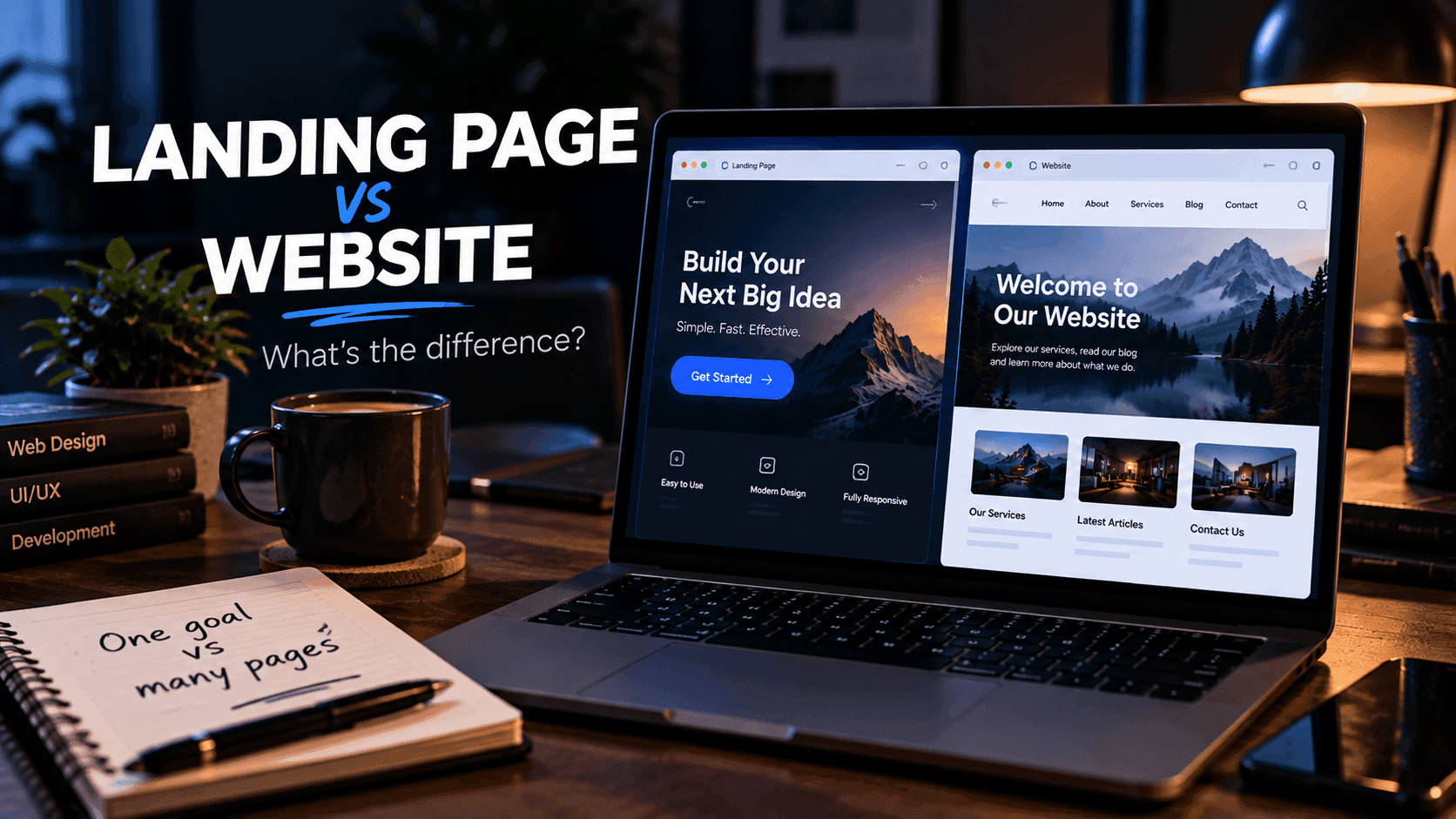
Landing pages and websites are both important parts of an online presence, but they serve different purposes.
A website usually provides broad information about a person, company or organization. A landing page is normally designed around a specific campaign, audience or action. Mixing the two up is one of the most common reasons a page feels unfocused.
Understanding the difference helps you decide what to build first, and how to make both work together.
Quick answer: A website is your broad online home with many pages and navigation. A landing page is a single focused page with one goal, such as a signup, download or purchase. Most businesses benefit from both.
What Is a Website?
A website is a collection of pages connected through navigation.
A business website might contain:
- Home
- About
- Services
- Portfolio
- Blog
- Contact
- FAQ
Visitors can explore different areas depending on their needs. One person might read the blog, another might check pricing and a third might look for contact details.
A website is useful when people need to learn about an organization over time or access different types of information. It is also where search engines, returning visitors and people who hear your name tend to end up.
What Is a Landing Page?
A landing page is more focused.
For example, a software company might create one landing page specifically for a new product launch. A freelancer might create another landing page for a paid consultation.
The page usually has one primary call to action, such as:
Book a Consultation
or:
Start Free
The goal is to reduce distractions and make the next step clear. Everything on the page, from the headline to the FAQ, supports that one action.
If you want to build one, our guide on how to create a landing page for free walks through the process step by step.
Key Differences
| Website | Landing page | |
|---|---|---|
| Purpose | Inform and let visitors explore | Drive one specific action |
| Navigation | Full menu and many links | Minimal or no navigation |
| Content | Broad information on many topics | Only what supports the offer |
| Traffic | Search, direct visits, referrals | Usually campaigns: ads, email, social posts |
| Lifespan | Long-term | Often tied to a campaign or offer |
| Success measure | Engagement across pages | Conversion rate for one action |
Purpose
A website provides information and navigation across multiple topics. A landing page focuses on one offer or action.
Navigation
Websites usually have menus and multiple links. Landing pages often reduce navigation to keep attention on the main goal, while still keeping essential links such as your privacy policy.
Content
A website can contain broad company information. A landing page usually contains only content directly related to a particular campaign, which makes it easier to write copy that matches what the visitor clicked on.
Traffic
Websites can receive traffic from many sources. Landing pages are often connected to advertising campaigns, email campaigns, search results or social media posts, where you know roughly what the visitor is looking for.
When Should You Use a Website?
Build a website when you need a permanent online presence.
Examples:
- Company website
- Developer portfolio
- Agency website
- Online publication
- Community
- Documentation site
A website provides the foundation where visitors can discover your broader content. It builds familiarity over time and gives people a place to return to.
When Should You Use a Landing Page?
Use a landing page when you have a specific objective.
Examples:
- Product launch
- Lead-generation campaign
- Free download
- Event registration
- Consultation booking
- Newsletter signup
You can have a landing page without replacing your main website. In fact, many sites have several landing pages, one for each campaign or audience.
Can You Use Both?
Absolutely, and most businesses do.
A common structure is:
Website → Information
Landing page → Specific campaign
For example, your main website could explain your web development services. A separate landing page could promote a free website audit, with a short form and nothing else to distract from it.
Here is how a visitor's journey might look when both work together:
Social media post → Landing page for a free audit → Audit request → Follow-up email → Services page on your website
The landing page captures interest for one offer. The website gives people more context when they are ready to learn more.
How Landing Pages Fit Into Funnels
A landing page is often the first step in a larger sequence called a sales funnel, which guides people from discovering an offer to taking action. If that idea is new to you, read what is a sales funnel for a beginner-friendly explanation.
How Tools Can Help
Developers can build landing pages manually, often reusing the design system of their main website. Our free templates are a quick starting point.
Marketing campaigns sometimes require more than a page, though: forms, email follow-up and funnels. An all-in-one platform such as systeme.io can be useful to explore when you need landing pages alongside those tools. See our systeme.io landing page guide for more information.
Which One Should You Build First?
If you need a long-term online presence, start with a website.
If you already have a website and want to promote one specific offer, create a landing page.
If you are testing a new idea, a focused landing page can also help you validate interest before investing in a larger website. A simple page with a clear explanation and an email signup will tell you whether people care enough to leave their details.
Frequently Asked Questions
What is the main difference between a landing page and a website?
A website is a collection of connected pages that covers many topics and lets visitors explore. A landing page is a single focused page built around one campaign, audience or action.
Can a landing page replace a website?
For a single offer or a quick test, a landing page can be enough. If you need a permanent online presence with information about your services, portfolio, blog or support, you will usually want a website too.
Is a homepage a landing page?
Not usually. A homepage introduces the whole business and offers many links. Any page can be where a visitor lands, but a true landing page is designed around one specific action.
Should I build a website or a landing page first?
Build a website first if you need a long-term presence. Start with a landing page if you want to promote one offer or test demand for an idea before investing in a larger site.
Final Takeaway
A website and a landing page are not competing concepts.
Think of the website as your broader online home and the landing page as a focused destination for a specific campaign or action. Using both can create a clearer experience for different types of visitors.
Related reading:
Disclosure: FreeDevTemplates may earn a commission if you sign up for systeme.io through links on our guide pages, at no additional cost to you. Read our affiliate disclosure.